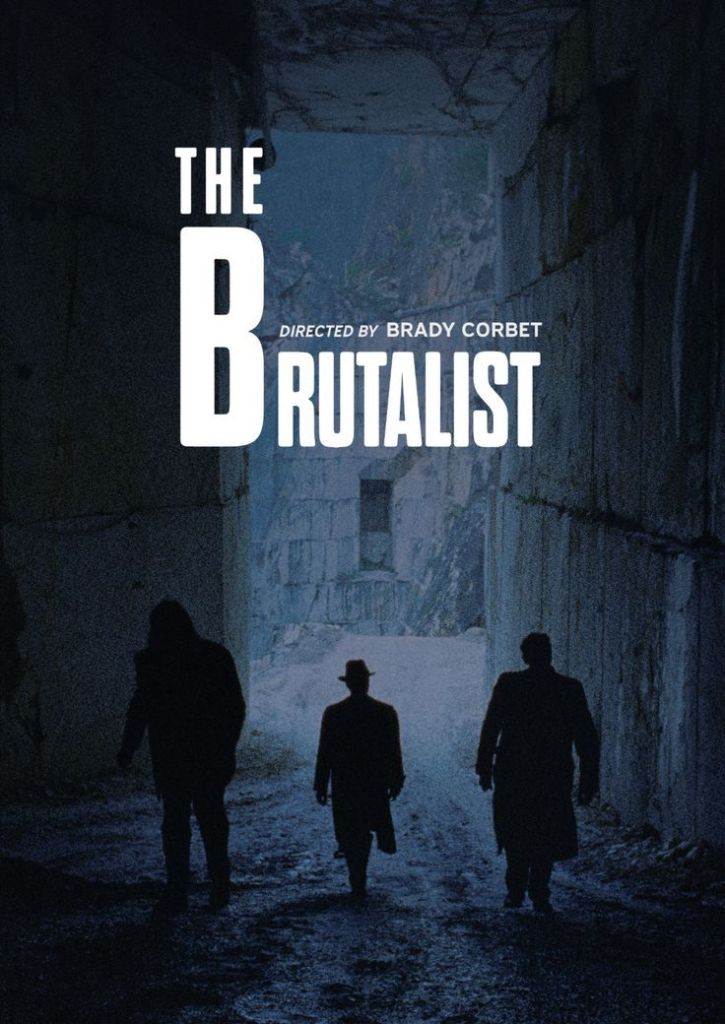
Brady Corbet’s The Brutalist is more than a film about architecture—it is a meditation on the fragility of ambition and the existential cost of survival. Through the story of László Tóth, a Hungarian-Jewish architect and Holocaust survivor, the film invites us into a world where art is both a sanctuary and a prison, and where the pursuit of an ideal threatens to consume the very essence of the dreamer.
Architecture as a Metaphor for Existence
From the outset, The Brutalist establishes architecture as more than mere construction—it is a philosophy, a way of being, an idea of survival. Tóth’s stark, imposing designs mirror the rigidity of his own existence, shaped by the traumas of war and the unyielding forces of history. His commitment to brutalist architecture—an aesthetic often dismissed as cold and austere—parallels his own struggle to reconcile past horrors with an uncertain future. In his concrete edifices, we see his longing for permanence, for structures that will withstand the erosions of time and memory. But like the brutalist movement itself, his work is met with resistance. The world desires beauty, fluidity, and spectacle, while he remains tethered to an ethos of survival, function, and durability. For him war was more than just an event that took place, it had become his identity.
The American Dream as a Labyrinth
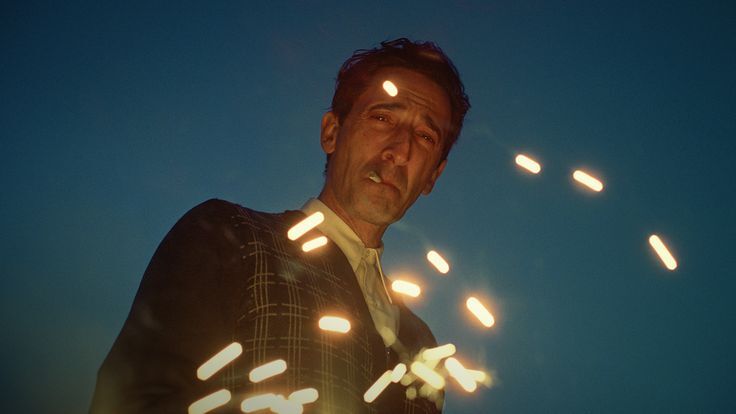
If Tóth’s designs are an attempt to impose order on a chaotic world, his journey in post-war America reveals the disorder lurking beneath the promise of reinvention. The film challenges the myth of the American Dream by exposing its contradictions—while the country offers freedom and opportunity, it demands conformity and compromise in return. Tóth is not merely an architect of buildings but an architect of identity, forced to reshape himself in order to be accepted. The patronage of industrialist Harrison Lee Van Buren at first appears to be a gift, a lifeline for an artist in exile. Yet, as the relationship deepens, the power imbalance becomes clear. Tóth, like many immigrants and visionaries before him, finds himself trapped in the paradox of assimilation: to survive, he must surrender pieces of himself.
The Weight of Creation
There is an existential tragedy at the heart of The Brutalist—the notion that to create is both an act of defiance and an act of submission. Tóth’s designs defy traditional beauty, yet they also yield to the demands of those who fund them. The question emerges: Can art remain pure when it is bound by the desires of patrons and the limitations of reality? This struggle mirrors a deeper human condition—the tension between self-determination and external forces, between the desire to shape one’s destiny and the constraints imposed by history, politics, and economics.
Existence as a Brutalist Structure
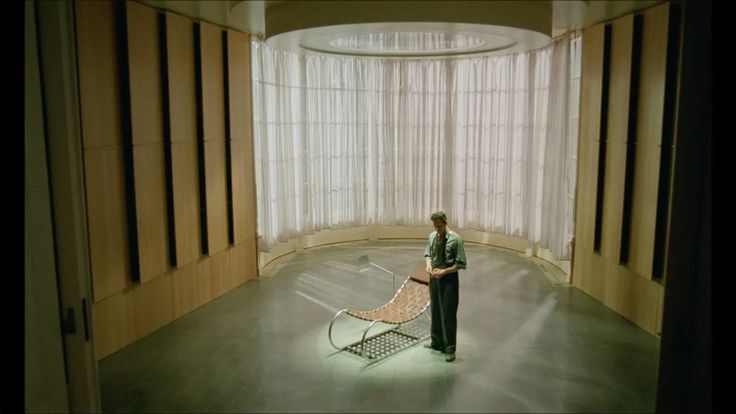
In the film’s final act, as Tóth’s legacy begins to solidify in concrete and steel, we are left with a lingering uncertainty. Has he built monuments to his survival, or tombs to his lost self? The film does not offer easy resolutions, nor does it romanticize the cost of greatness. Instead, it leaves us with the unsettling realization that existence itself is brutalist in nature—shaped by forces beyond our control, defined by both resilience and resignation. The structures we build, whether in architecture or in identity, stand as testaments to our struggle to leave a mark, even as time and history threaten to erode them.
In this way, The Brutalist is not just a film about an architect—it is a meditation on the very nature of being. Like the raw concrete of its namesake, it is stark, unflinching, and profoundly human.
 Cinematic Sojourns
Leave a comment